History
In colonial Mexico, the word china was used for people who came from Asia on the Manila galleons, and later also for servants and for women of mixed descent. A well-known legend links the dress to Catarina de San Juan, a woman from Asia who was brought to Puebla as a slave in the seventeenth century and became famous for her piety. Many historians doubt this story: the dress she is said to have worn has little in common with the outfit known today, and the legend seems to have grown up much later.
In the nineteenth century, china or china poblana described a lively young woman of the urban working class, known for her striking clothes: a low-cut white blouse embroidered with silk and beads, a bright full skirt and a rebozo. Travellers and artists such as Carl Nebel drew these women in Puebla and Mexico City, and writers presented them as a typically Mexican figure, often alongside the chinaco, a horseman of the same class.
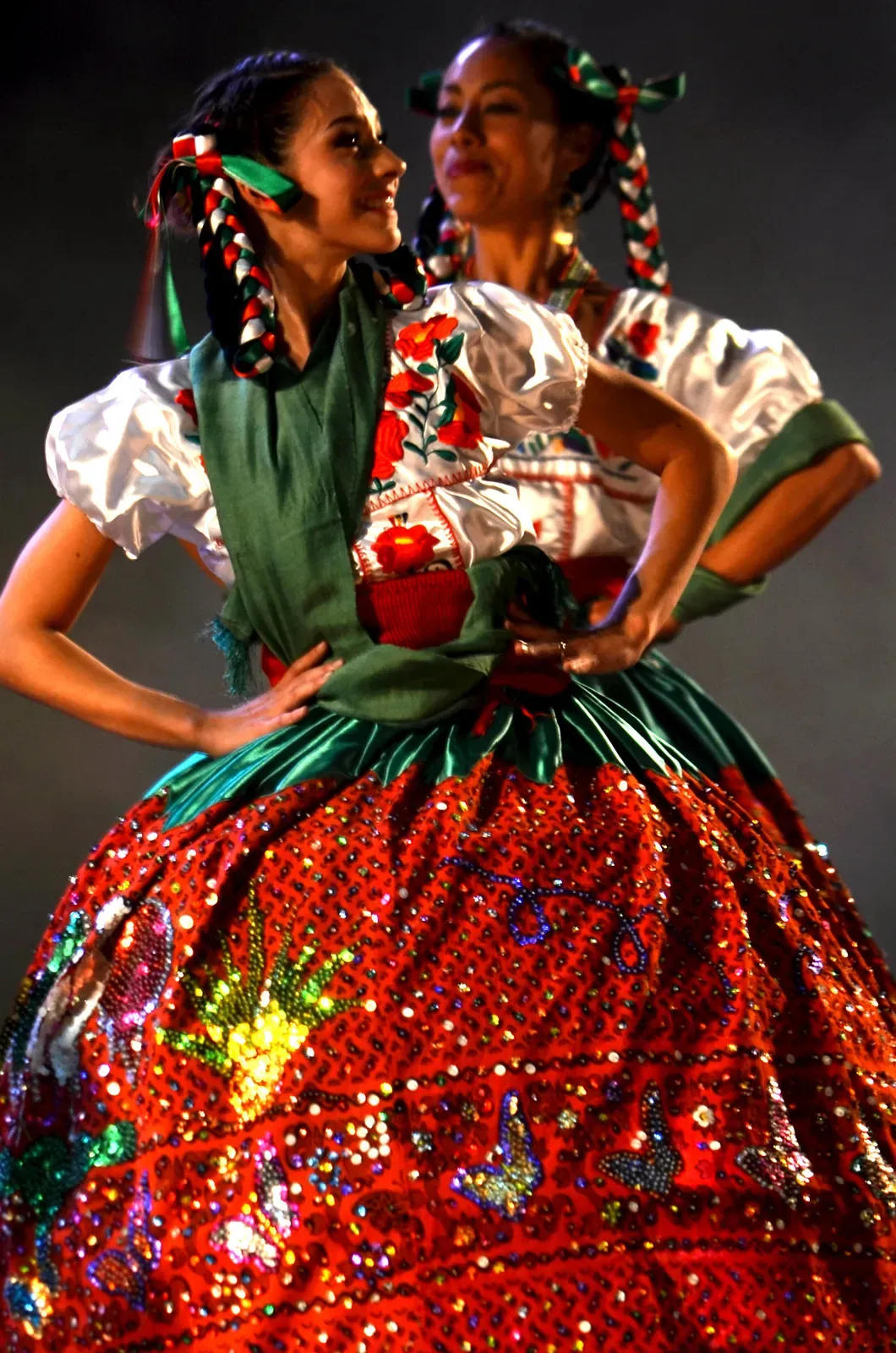
In the twentieth century the china poblana became a symbol of the nation. Theatre, dance and cinema turned her outfit into a stage costume with sequins, beads and the eagle of the Mexican flag, and she became the partner of the charro in the jarabe tapatío, often called Mexico’s national dance.
The parts of the outfit
- Camisa: a white blouse with short or puffed sleeves and a wide neckline, embroidered with flowers in coloured silk thread and glass beads (chaquira).
- Castor skirt: a full skirt that reaches the ankles. The upper part is usually green and the lower part red, and both are densely decorated with sequins (lentejuelas) and beads in flowers, geometric designs or the eagle from Mexico’s coat of arms.
- Petticoat: a white petticoat with a lace edge that shows below the hem of the skirt.
- Rebozo: a shawl, often of fine silk, crossed over the chest and tucked into the waist, or worn over the shoulders.
- Sash: a coloured sash (faja) tied around the waist, over which the blouse falls.
How it is worn
The petticoat and skirt are put on first, then the blouse, with the sash tied around the waist and the rebozo crossed over the chest. The outfit is completed with:
- Hair: two long braids woven with ribbons in red, white and green, sometimes pinned up with flowers.
- Jewellery: earrings, necklaces of beads or coral and gold or silver pieces.
- Shoes: low satin or embroidered shoes, or heeled shoes for dance.
When a couple dances the jarabe tapatío, the woman wears the china poblana and the man wears the traje de charro. Many groups also dance it in the ribboned skirts of Jalisco.
Where you see it today
The china poblana is not everyday dress but a costume for festive and patriotic occasions:
- Independence Day: on 15 and 16 September girls and women dress as chinas poblanas, and children often wear the outfit at school celebrations.
- Puebla: the city treats the costume as part of its identity, and chinas poblanas appear in festivals and parades such as the one for the Battle of Puebla on 5 May.
- Folklórico dance: dance groups in Mexico and abroad perform the jarabe tapatío in china poblana dress.
The china poblana is also shown in museums, on posters and in art as an image of Mexico. To see it alongside the huipil, rebozo and Tehuana dress, visit traditional clothing in Mexico.